
The CompactFlash Association (CFA) has developed specifications for the following industry standards, or card types, in the removable media industry: CFexpress®, CFAST®, XQD®, and CompactFlash®. Each industry standard has its own set of specifications, and some standards have multiple versions due to technology advancements.
Knowing the existence of the specifications available, whether it be versions of CFexpress or VPG, can be helpful for end users to make the best purchase decision for their needs.
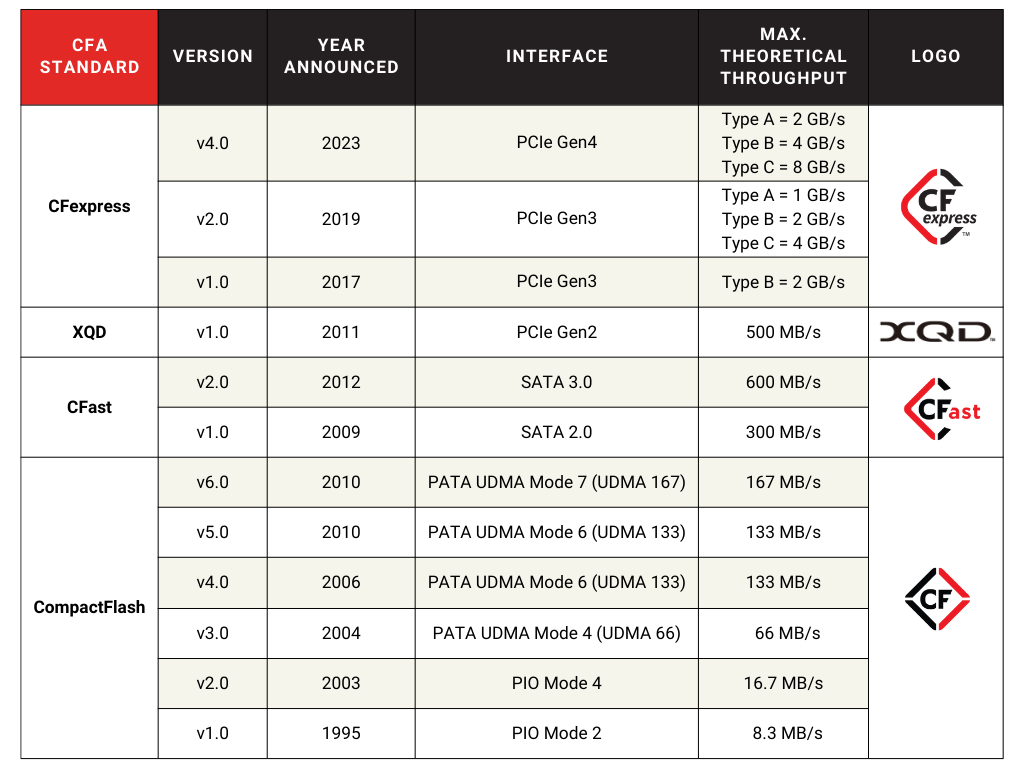
A table listing all of CFA’s specifications from 1995 to date, along with their corresponding logos seen on memory cards.
Any company that plans to design, manufacture, market, or sell CFA-defined products are required to obtain licensing from CFA for its specifications, trademarks and logos.
The latest industry standard, CFexpress, offers the highest performance, highest capacity, and highest reliability removable storage solutions to the market.
There are 3 releases of the CFexpress specification: 1.0, 2.0, and 4.0.
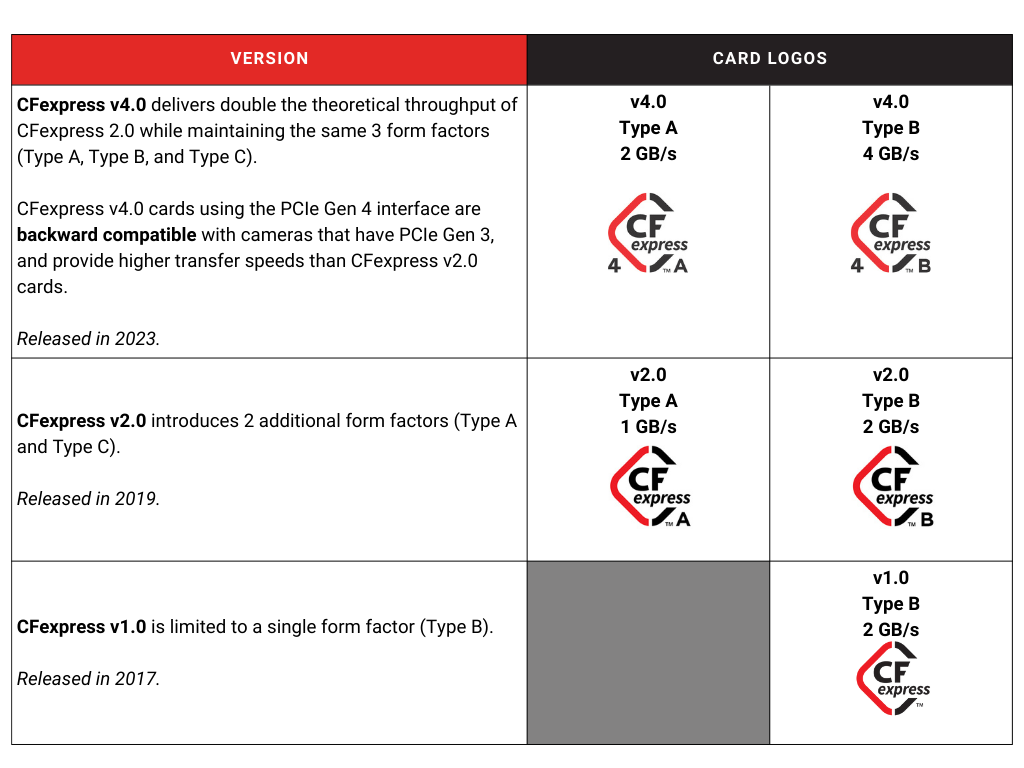
CFexpress cards have three different form factors (Type A, Type B, and Type C) to better serve the needs of a wide range of cameras. For example, CFexpress Type A cards have a smaller form factor, so they can be used for more compact cameras.
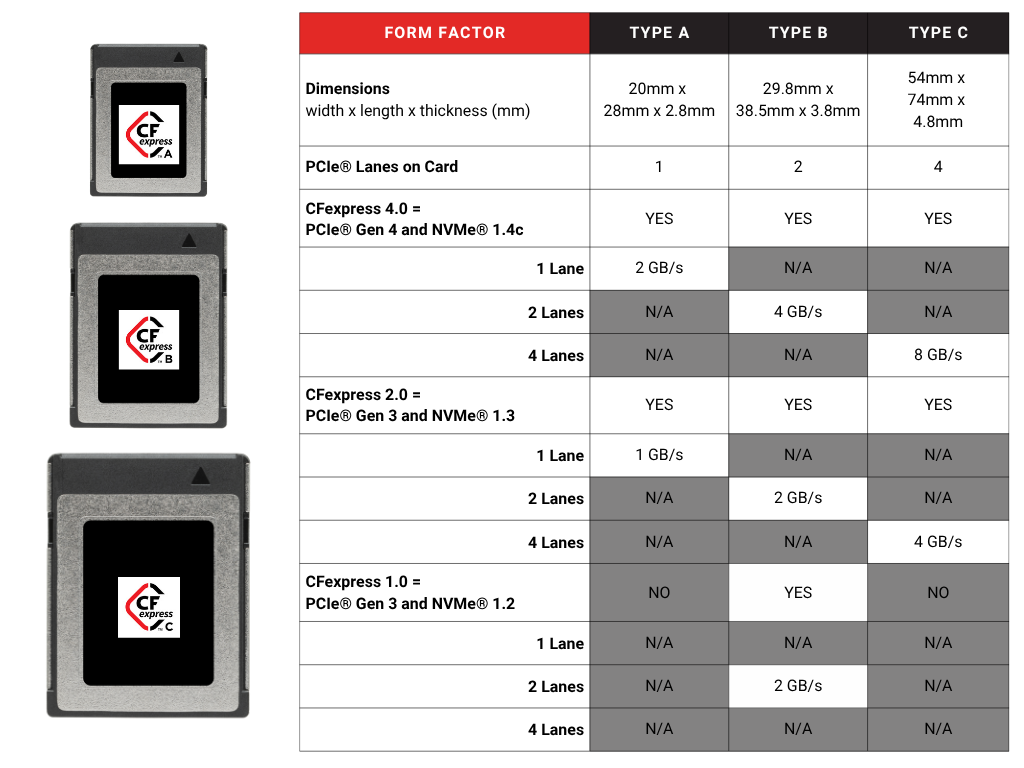
This table highlights the dimensions, interfaces, and bus theoretical data transfer speeds (in Gigabytes per second) for each of the three CFexpress form factors: Type A, Type B*, and Type C**.
*CFexpress Type B cards have the same dimension and connector as XQD cards. Some cameras may choose to update their XQD cameras to also support CFexpress Type B cards.
**At this time, there are no cameras or cards that take CFexpress Type C.
An explanation of the various symbols, labels, and logos on a CFexpress card. For more explanations of CFA-related terminology, view the Glossary of Terms.
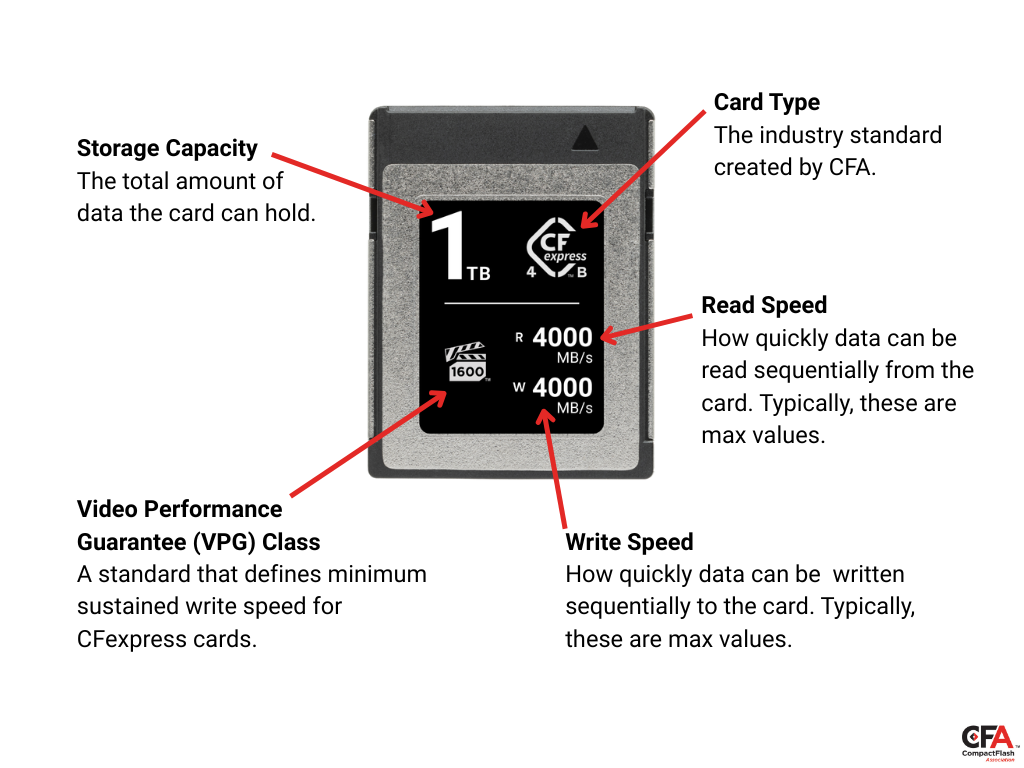
CFexpress cards are built using PCIe® interface and NVMe® protocol. This allows them to deliver extremely fast read and write speeds, making them ideal for 4K, 6K, and 8K video recording, high-framerate recording, and continuous burst shooting.
What CFexpress speeds means for card users:
If you’ve ever hit a recording limit because your card couldn’t keep up, this is what CFexpress is designed to solve. Higher sustained write speeds help maintain reliable recording at high bitrates and reduce workflow delays during file transfers. Learn more about Video Performance Guarantee (VPG) certification, which guarantees a card’s minimum sustained write speed for even more reliability.
CFexpress cards support very high storage capacities, allowing creators to record longer takes, shoot more RAW photos, and capture high-resolution video without constantly changing cards during production.
Higher CFexpress capacities means:
Higher capacities allow card users to manage demanding video formats and large file sizes more efficiently during professional workflows.
CFexpress Type A and Type B differ in physical size and maximum speed. Type A is smaller and uses one PCIe lane, while Type B is larger and uses two PCIe lanes, allowing double the maximum speed. Both formats follow the CFexpress standard and are selected by camera manufacturers based on media performance, and capacity requirements. Your camera determines which form factor you need for its capabilities.
Some highlighted differences between CFexpress Type A and CFexpress Type B:
Yes, CFexpress Type B can support double the maximum speed than Type A because CFexpress Type B uses two PCIe lanes, while CFexpress Type A uses one PCIe lane.
This makes Type B cards ideal for extremely high bitrate recording and data-intensive workflows. For example, advanced cinema cameras often use CFexpress Type B cards to support demanding recording formats.
Memory cards that are manufactured according to the CFexpress standard have an official CFA logo indication. A card that has the letter “A” on the bottom right of the CFexpress logo is CFexpress Type A. A card that has the letter “B” on the bottom right of the CFexpress logo is CFexpress Type B.
Note: If you see the CFexpress logo with a “4” on the bottom left, it means the card uses CFexpress version 4.0.

Left: CFexpress Type A, version 2.0 card logo
Right: CFexpress Type B, version 4.0 card logo
CFexpress and SD are different memory card formats designed for different performance requirements. SD cards are widely used across many devices and applications. CFexpress supports significantly higher sustained performance and greater scalability, making it well suited for professional imaging and high-data-rate video recording. CFexpress cards are also uniquely able to receive Video Performance Guarantee (VPG) certification for guaranteed minimum sustained write speed.
The appropriate format depends on the camera design and recording requirements. CFexpress is commonly used in advanced professional systems where higher throughput is required.

Announced in: 2012
Interface: PCI Express (PCIe) Gen 1
XQD cards support bus speeds up to 250MB/s, and provide a solid base for future performance enhancements. XQD cards have the same form factor as CFexpress Type B cards.
The XQD™ trademark and logo are owned solely and exclusively by Sony Corporation and have been licensed to CFA with rights to sublicense to CFA members in good standing who have executed the CFA License and Sublicense Agreement.
Announced in: 2009 (v1.1), 2012 (v2.0)
Interface: Serial ATA Gen II interface (SATA-II)
The CFast 2.0 specification supports bus speeds up to 600MB/s, while the CFast 1.1 specification supports bus speeds up to 300MB/s.
The CFast® logo and trademark are owned solely and exclusively by the CompactFlash Association.

Announced in: 1995-2010
Interface: Parallel ATA (PATA)
CompactFlash storage cards are preferred by professionals for both their performance and handling characteristics.
The CompactFlash® trademark and the CF 4.1 logo are owned solely and exclusively by SanDisk Corporation and have been licensed to the CompactFlash Association (“CFA”) with rights to sublicense to CFA members in good standing who have executed the CFA License and Sublicense Agreement.